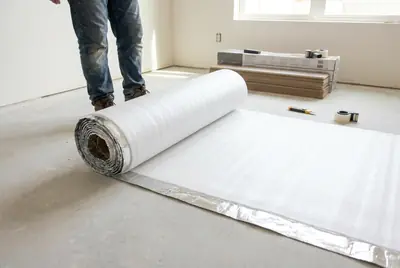
01
Underlayment and vapor film
The quiet half of a quiet floor: foam or fiber underlay with taped seams, plus a moisture film wherever concrete sits below.

Our Walnut Creek fitters level, lay and trim click-lock laminate across Madison County, and the square-foot price is on paper before the first box opens.
Measured square-foot quote, free, answered within one business day.
Are you tired of worn-out floors that make your home look drab? You're ready for a change, a real upgrade that brightens your living space and adds lasting value. This guide will show you how to achieve that beautiful, new-look floor you've been dreaming of.
Imagine stepping onto floors that are not only stunning to look at but also tough enough to handle everyday life, from rambunctious kids to energetic pets. You deserve a home that reflects your style and stands up to the demands of your busy schedule. That's exactly what we're here to talk about today: transforming your living areas with surfaces that offer both aesthetic appeal and serious resilience.
Choosing the right kind of flooring can feel like navigating a maze, can't it? You want something that looks fantastic, lasts for ages, and won't require you to sell a kidney to afford it. It's a big decision, and frankly, there are a lot of options out there that can make your head spin faster than a tumble dryer.
Let's dive into what makes certain floor types stand out for homeowners who want a blend of good looks and practicality. You're probably looking for something that mimics the natural beauty of wood or stone but comes with fewer headaches and a more wallet-friendly price tag. This is where the magic of modern material science really shines through.
You see, the advancements in manufacturing mean you can get surfaces that look incredibly convincing, offering that rich texture and depth you love. These materials are designed to be remarkably resistant to scratches and scuffs, which is a massive win for anyone with a household full of activity. Plus, they're often a breeze to clean, meaning less time spent scrubbing and more time enjoying your home.
Think about the kind of wear and tear floors typically endure. Spills happen, dropped toys are a given, and muddy paws are an unfortunate reality for many of us. You need a floor that can take a beating and still look good, day in and day out. This is where a particular type of layered flooring really shines, offering a fantastic solution for busy households.
Picture this: the warm, inviting look of hardwood floors gracing your living room, dining area, or even your kitchen. Now, imagine achieving that same visual appeal without the hefty price tag or the constant worry about moisture damage or scratches. This is the promise of many modern flooring solutions designed for real life.
These innovative floor coverings are engineered with multiple layers, each serving a specific purpose. The top layer, often called the wear layer, is where the magic happens. It's specially treated to resist all sorts of daily onslaughts, from spilled juice to the claws of your furry companions.
Then there's the decorative layer. This is the part that gives you that stunning visual, meticulously crafted to replicate the intricate grain patterns and natural variations of real wood. It's this attention to detail that makes these floors so appealing, providing a sophisticated foundation for your home's decor.
You're not just getting a pretty surface either. Beneath that lies a core layer that provides stability and structure, often made from high-density fiberboard or a similar robust material. This core is what gives the flooring its strength and helps it resist warping or buckling, even in areas prone to humidity changes.
Now, let's talk about why you might seriously consider this kind of flooring for your abode. For starters, its durability is a major selling point. You're investing in a floor that's built to last, capable of withstanding the bumps and bruises of daily life with remarkable grace.
Think about the peace of mind that comes with knowing your floors can handle a dropped plate or a pet's enthusiastic greeting. This is not just about saving money on repairs down the line it's about reducing stress and enjoying your home without constant vigilance.
Furthermore, the ease of maintenance is a huge benefit. Cleaning up spills is usually as simple as wiping them away with a damp cloth, and regular sweeping or vacuuming keeps them looking fresh. This means less time spent on your hands and knees and more time doing what you actually enjoy.
And let's not forget about the sheer variety available. You can find these impressive floors in a vast array of colors, styles, and finishes, allowing you to perfectly match your existing decor or create a brand-new look for your space. Whether you're drawn to the rustic charm of a distressed wood grain or the sleek sophistication of a darker, modern tone, you'll find an option that speaks to your personal taste.
So, you're ready to take the plunge and get these beautiful, resilient floors installed. What does that actually look like? Well, for starters, it's a process that benefits greatly from professional attention. Trying to tackle it yourself can sometimes lead to unexpected headaches and results that aren't quite what you envisioned.
A skilled installer knows the ins and outs of preparing your subfloor, ensuring it's clean, level, and ready for the new material. This preparation is absolutely critical for a flawless finish and a floor that will stand the test of time. Skipping this step is like building a house on a shaky foundation, not a good idea.
They'll meticulously measure and cut each piece to fit perfectly around doorways, corners, and any other architectural features. This precision is what separates a professional job from a DIY attempt that might leave you with unsightly gaps or uneven edges. It's all about those fine details.
Furthermore, depending on the specific type of layered flooring you choose, the installation method can vary. Some systems click together with a special tongue-and-groove mechanism, while others might involve adhesives. A seasoned professional will know the best approach for your particular product and subfloor situation.
Investing in new flooring isn't just about aesthetics it's also a smart move for your home's overall value. When it's time to sell, potential buyers often notice and appreciate updated flooring. It signals that the home has been well-maintained and cared for.
This kind of high-quality, resilient flooring can be a significant selling point, potentially leading to a quicker sale and a better offer. It's a tangible improvement that buyers can see and feel, contributing to their overall impression of the property.
Moreover, the longevity of these floors means you won't have to worry about replacing them again for a very long time. This translates to long-term savings and a reduction in future renovation hassles. You're essentially future-proofing your home's flooring.
With so many options available, how do you choose the perfect floor for your home? It really comes down to a few key considerations. First, think about the room itself and its intended use. A high-traffic area like a kitchen or entryway might benefit from a surface with an even higher level of scratch and water resistance.
Then, consider your personal style. Do you lean towards a light and airy feel, or do you prefer something darker and more dramatic? Look at samples in your own home, under different lighting conditions, to see how they truly look and feel. What might look good in a showroom might be a completely different story in your actual living space.
Don't underestimate the importance of the wear layer's rating either. This number indicates how well the floor will hold up against abrasion and daily use. A higher rating is generally better for busy households. It's a technical detail, sure, but it's one that directly impacts your experience with the floor.
While the idea of DIY might be tempting, especially when you're trying to keep costs down, there's a strong argument to be made for hiring professionals for laminate flooring installation in Walnut Creek, North Carolina. Think about it: you're investing in a quality product, and you want it installed correctly to ensure it performs as promised for years to come.
A seasoned installer brings a level of expertise that's hard to replicate. They understand the nuances of subfloor preparation, which is absolutely paramount. A perfectly level and clean subfloor prevents issues like squeaking or the flooring separating down the line. It's the hidden groundwork that makes all the difference.
They also have the specialized tools needed to achieve a seamless finish. Cutting precise angles around cabinets, doorways, and corners requires skill and the right equipment. You want those edges to look clean and professional, not jagged and haphazard.
Additionally, professionals are familiar with the specific installation methods for different types of layered flooring. Whether it's a click-lock system or one that requires adhesive, they know the best practices to ensure a secure and long-lasting fit. This expertise can save you a lot of headaches and potential costly mistakes.
Ultimately, the goal is to create a home environment that you love spending time in. Beautiful, functional flooring plays a huge role in that. It's a foundational element that impacts the overall atmosphere and your daily experience within your living space.
When you choose a flooring option that's both visually appealing and incredibly resilient, you're not just making a purchase you're making an investment in your home and your lifestyle. You're creating a space that's a joy to live in, one that can handle whatever life throws at it.
Imagine hosting friends and family without the constant worry about spills or scuffs. Picture your kids or pets playing freely on floors that are designed to withstand their energy. This is the kind of freedom and peace of mind that comes with making the right flooring choice.
Living in an area like Walnut Creek, North Carolina, means you're part of a community with its own unique charm. Perhaps you're in the 27889 or 27890 ZIP codes, or maybe another part of Madison County. Whatever your specific locale within this pleasant part of NC, your home deserves flooring that complements its setting and your personal style.
You've got a community with a median household income that suggests a focus on practical, value-driven choices, and that's exactly what we aim to provide. We understand that homeowners here are looking for solutions that offer long-term benefits without breaking the bank. It's about smart investments for a beautiful home.
The population of Walnut Creek is around 835 residents, a friendly community where word-of-mouth and a good reputation matter. That's why we're committed to delivering exceptional quality and service that speaks for itself. Your satisfaction is our highest priority, and we want to ensure your new floors are a source of pride for years to come.
Ready to explore the possibilities and see how new flooring can transform your home? Taking the first step is often the easiest. You don't need to be an expert or have all the technical details figured out. That's what we're here for.
We can help you navigate the different options, explain the benefits in plain language, and answer all your questions. Our goal is to make the process as smooth and stress-free as possible for you.
Think about the satisfaction of walking into a room with gorgeous, durable floors that you absolutely love. It's a feeling that adds so much to your daily life, and it's more achievable than you might think.
We offer free, no-obligation estimates. This is your chance to get a clear picture of what's involved, understand the costs, and see the quality of materials and workmanship we provide. There's no pressure, just helpful information to guide your decision.
So, why wait any longer to give your home the upgrade it deserves? Let us help you bring your vision to life with beautiful, resilient flooring that you'll enjoy for many years. Your dream floors are just a step away.
Every laminate plank carries an abrasion class. It says more about how the floor will age than the photo on the box does, so we quote with it, not around it.
| Rating | Where it belongs | What it takes in stride |
|---|---|---|
| AC3 | Bedrooms, closets, home offices with a chair mat | Everyday footsteps, furniture on felt pads, the vacuum on Sundays |
| AC4 | Living rooms, kitchens, hallways, stair landings | Kids, dogs, dropped keys, the daily route between couch and fridge |
| AC5 | Entryways, home businesses, rentals, busy stairs | Grit walked in from outside, rolling office chairs, tenants you never meet |
AC1 and AC2 exist too; we simply do not lay them, because the savings at the register come back as dull traffic lanes within a couple of years.
We install laminate all day, and it is still not the answer to every room. Here is the comparison we walk through at the kitchen table, with nothing rounded in our favor.
| Laminate | Vinyl plank | |
|---|---|---|
| Water | Modern boards shrug off spills that get wiped up; standing water at a leaky dishwasher is still its weak spot. | Fully waterproof through the core, which is why laundry rooms and full bathrooms lean vinyl. |
| Comfort and sound | Stiffer core, more solid underfoot, and quieter than its reputation once a proper underlay goes in. | Softer and warmer to bare feet, but thin planks telegraph every dip in the subfloor. |
| Price | More floor per dollar at the same thickness, and the realistic wood looks start cheaper. | Comparable at the low end; the rigid-core boards worth owning cost noticeably more. |
| Repair | A click-lock plank can be swapped; keep one spare box in the garage and a scratch is an afternoon fix. | Glued-down planks mean solvent and patience; click vinyl swaps much like laminate does. |
If your project reads vinyl after that table, we will say so during the measure and you keep the comparison for free.
01
The quiet half of a quiet floor: foam or fiber underlay with taped seams, plus a moisture film wherever concrete sits below.
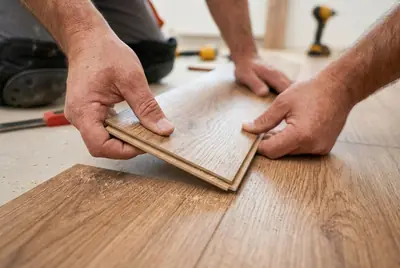
02
Planks angled, clicked and tapped home with staggered joints, so the sight line down the room stays dead straight.
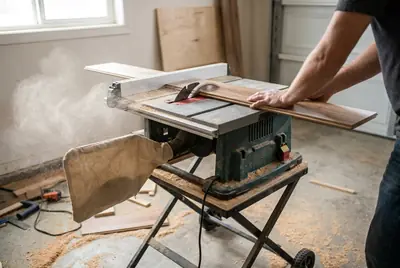
03
Door casings undercut so boards slide beneath, pipes ringed with collars, last rows ripped to width instead of forced.
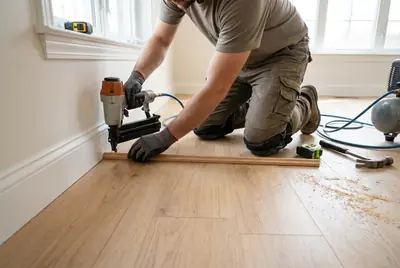
04
The expansion gap disappears behind clean trim, mitered at the corners and caulked where the wall waves.
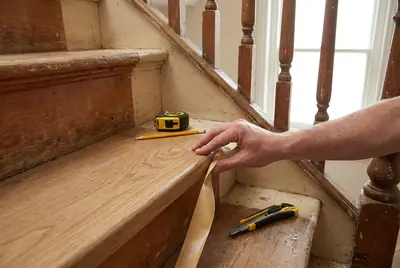
05
Tread and riser kits with proper nosing, glued and screwed, because a stair takes more abuse than any floor below it.
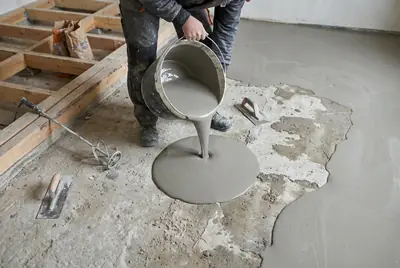
06
Grinding the high spots and pouring self-leveler into the low ones before a single plank leaves its box.
Laminate floats. It is not nailed and not glued, which is exactly why it goes down fast, and exactly why it copies every flaw underneath. A hollow click under your heel, a seam that opens by the window, a plank that rocks by the couch: nine times out of ten the story started below the boards.
So the level comes out before the saw does. We check flatness against the 3/16 inch in 10 feet rule, grind ridges, fill dips with self-leveling compound and let it cure. The underlay then earns its keep twice over, softening footfall sound for the room below and evening out what the compound did not catch.
The last quiet detail is the gap you will never see. Laminate grows and shrinks with the seasons, so every wall, pipe and doorway keeps a small expansion space, and long open stretches get a transition profile. Skip those and summer humidity will fold a hallway into a tent; leave them and the floor stays flat for decades. They are in every quote we write, not on the options list.
A fitter walks the rooms with a laser measure, checks the subfloor and leaves you a square-foot price on paper. No estimate ranges that grow later.
The planks acclimate in the rooms for about 48 hours while we pull the old covering and level whatever the laser flagged.
Underlay, film, then row after row, clicked tight and cut clean at every casing. Most single floors go down between breakfast and dinner.
Baseboards, thresholds, a vacuum pass and a walk through every room together. You keep the leftover planks for future repairs.
| Line item | Usual range | What sits inside it |
|---|---|---|
| Laminate installation, per sqft | $2.50 - $4.50 | Labor for click-lock laying with standard underlay included. |
| Old floor removal, per sqft | $0.60 - $1.50 | Carpet pulls out cheap; glued wood and tile sit at the top end. |
| Subfloor leveling, per sqft treated | $1.00 - $3.00 | Only the flagged low spots pay, never the whole room. |
| Stairs, per step | $45 - $95 | Tread, riser and nosing, fitted, glued and screwed. |
| Baseboard and quarter round, per linear foot | $2.00 - $4.00 | Supplied primed or color-matched to the boards. |
| Small-job minimum | $350 | Keeps a single hallway or one bedroom fair for both sides. |
The planks themselves ride on top of these figures and depend on the board you fall for; the written quote lists them on their own line, so you can swap styles without redoing the math.
Bedrooms, living rooms, hallways and home offices are laminate country, no caveats: warm looks, an AC rating matched to the traffic and a surface that forgives chair legs and dog claws better than the veneer floors it imitates.
Kitchens work well with a water-resistant board, sealed edges and a mat where the sink drips. Full bathrooms are the one room where we tap the brakes: daily steam and puddled water shorten any laminate's life, and we would rather point you to a different surface there than sell you a floor with a countdown on it. Powder rooms, with no tub in sight, are fine.
The moment the last plank clicks. A floating floor needs no glue to cure, so the couch returns the same evening and the bedroom sleeps in its own bed that night. Heavy aquariums and pianos get felt pads and a second pair of hands, not a waiting period.
Planks leave a cold warehouse and arrive in your heated rooms around Walnut Creek. Two days of acclimating lets them finish their expanding before they are locked together, instead of after, which is how gaps and peaks are born.
Usually, and it saves the demolition line on the quote. The grout lines disappear under the underlay if the tile is flat and sound. Over carpet the answer is always no; the padding flexes and the locks work themselves open.
We work room by room, shifting pieces to the finished side as the floor advances, so nobody rents a storage unit for a two-day job. Emptying closets and small breakables ahead of us is the one favor we ask.
No. A flat subfloor with an 8 mm AC4 board outlives a wavy one with 12 mm every time. Thickness buys sound and feel; the AC rating buys longevity; the leveling buys both. We spend your budget in that order.
You hand us the spare box we left behind. A click-lock floor unzips to the wounded plank and closes again, and a repair like that is an afternoon, not a renovation.
Terrain up here, coverage down there: every community a fitter reaches from this base is linked further down the page.
Somewhere under that carpet is a flat, quiet floor waiting to happen.
Price my floor